
Dangerous goods consulting in MiamiWe can build the declaration. We cannot take your name off it.
Under 49 CFR 173.22 the person offering the material classifies it, packs it in the right packaging, and closes that packaging the way the manufacturer says. A forwarder can sign the certification on your behalf. The duty stays with you. That is the whole reason it is worth having someone competent in the file, and the reason we tell you what we are looking at instead of quietly fixing it.
Send the SDS and we will come back inside 4 business hours, Monday–Friday, 8:30 AM – 5:00 PM ET.
Dangerous goods: who is actually responsible for what.
Most dangerous goods pages are careful never to say this out loud, because it makes the service sound smaller. It does the opposite: it tells you what you are buying.
- Classifying the material correctly, from your own data
- Using packaging authorized for that UN number
- Closing the packaging per the manufacturer’s instructions, and keeping those instructions on file
- The accuracy of what the declaration says about your product
- Your own hazmat employee training, if your staff handle or offer it
- Reading the safety data sheet and working the classification with you
- Building the Shipper’s Declaration, and signing it as your agent
- Marks, labels, overpack marking and placarding
- The emergency response number and the name that has to travel with it
- Segregation checks before anything goes in one box
- The container packing certificate on ocean units we load
- Booking against the carrier and state variations that actually apply
If we think a classification is wrong, you will hear it from us before the booking, not from an inspector after. That conversation is uncomfortable about once a year and it has never once been the expensive option.
Five things on the outside of the box.
Everything below is the shipper’s to get right, and every one of them is a reason a package gets refused at the counter. We check them before the freight leaves, not after.
- Proper shipping name and UN numberNot your product name, not the trade name. The entry from the dangerous goods list, with the identification number beside it.49 CFR 172.301
- Hazard class label, and any subsidiaryDiamond on the same surface as the marks, undamaged and unobscured. A second label where the material carries a subsidiary risk.49 CFR 172.400
- Orientation arrowsOn two opposite vertical sides, pointing up, where the packaging holds liquid. Missing arrows get a package rejected at acceptance more often than anything else on this list.49 CFR 172.312
- Handling marks that applyLimited quantity, excepted quantity, the lithium battery mark, marine pollutant, overpack. Each has its own size rule and its own trigger.49 CFR 172 subpart D
- Consignor and consigneeFull name and address on the package itself, not only on the paperwork that travels with it.49 CFR 172.301(d)
Every one of these is a shipper obligation under 49 CFR, and none of them transfer to us because we prepared the paperwork. What we can do is catch them while the box is still open.
Hazmat by air, ocean and road. Three rulebooks, one shipment.
The same drum is a different problem depending on how it travels. Air is the strictest and the least forgiving. Ocean gives you room and takes it back in stowage. Road is where the US rules are their own thing.
- Classification from your SDS against the current edition, not the one we have on the shelf.
- Packing instruction and quantity limits checked per aircraft type, passenger and cargo.
- State and operator variations read for the actual routing. A commodity accepted by one carrier is refused by the next.
- Shipper’s Declaration built and checked line by line, because the acceptance check at the counter is unforgiving.
- Lithium batteries handled against the current guidance, including the state of charge rule.
- Segregation settled before anything is loaded into one unit.
- Container packing certificate signed by us on the units we stuff, as 49 CFR 176.27(c) requires.
- Marking and placarding on the unit, including the ones that change between the road leg and the sea leg.
- Earlier cutoff. Hazmat closes 24 hours before the general cargo cutoff on the lane, and the classification, packaging and segregation review have to be settled before that.
- Bonded CFS handling, so a hazmat consignment does not sit at the terminal waiting on paperwork.
- Segregation on the vehicle under 49 CFR 177.848, which is a different table from the vessel one.
- Placarding under 172.504, including the Class 9 rule that changes the moment the box goes on the water.
- Shipping papers with the emergency response number, monitored while the material is in transit.
- Our own drivers on the South Florida legs, trained for what is on the truck.
- In-bond hazmat movements on bonded trucks and bonded drivers.
Nine classes.
Class is where every dangerous goods conversation starts and almost none of them finish. The entry for your specific UN number in the 172.101 table can be stricter than the class rule, and where the two disagree, the entry wins.
We keep the working reference on a separate page: segregation tables, labels, handling marks, the battery entries. Free, no login, because it is more useful there than buried in a sales pitch.
Will these two classes travel together?
Pick the hazard classes going into one container or one trailer and get a straight answer, checked against the 49 CFR vessel and highway tables. Full segregation matrices, every hazard label, the handling marks, and the six lithium and sodium-ion battery entries under IMDG 42-24.
We built it because we needed it. It is public because there is no good reason for it not to be.
Batteries, and the rules that changed under people.
More dangerous goods shipments are stopped by lithium batteries than by anything else, and most of the people shipping them do not think of themselves as hazmat shippers at all.
Lithium-ion cells and batteries shipped on their own by air must not exceed 30 percent of rated capacity. Under the current edition this is mandatory, not advisory. A full battery is a refused booking.
Lithium-ion batteries shipped alone. Forbidden as cargo on passenger aircraft. If your routing has a passenger leg in it, the answer changes before the packing does.
Section II is the small-quantity relief: no declaration, no Class 9 label, the battery mark instead. Cross the threshold and you are in IA or IB with UN specification packaging and a full declaration. The line is easy to cross by accident.
Sodium-ion entries, new and already carried under IMDG 42-24. The US rules have not caught up yet. They sit in a proposed rule, which is exactly the gap the board at the top of this page is about.
Swollen, damaged or recalled cells are not an ordinary booking. By air they are effectively off the table outside an approved arrangement. By sea there is a route, under special provisions and specific packagings.
The battery label goes on the package. The plain Class 9 placard goes on the container. Putting the battery label on the unit is one of the most visible errors you can make on a box.
The full battery reference is on the dangerous goods resources page: all six UN entries, the mark dimensions, the packing instructions and the dates. If you are not sure which entry you are shipping under, send us the cell specification and we will tell you.
The numbers behind the paperwork.
Our own staff are dangerous goods trained and certified, and the certification is recurrent. It expires and gets renewed, which is the part people forget about their own. If you offer hazmat, your employees need training too, and it is not satisfied by your forwarder having it.
What actually bites on a Miami to Latin America lane.
The cutoff moves 24 hours. Hazmat closes a full day before the general cargo cutoff on the lane. Classification, packaging, marking and the declaration all have to be right before that, not at it. Booking hazmat on the general cargo clock is the single most common reason a consignment misses a sailing, and it usually has nothing to do with the paperwork being wrong.
State and operator variations decide bookings. The base entry in the DGR is where you start. Brazil’s state variation BRG-05 requires a packaging certificate to travel with dangerous goods shipments by air. Miss it and the carrier refuses the booking, on a lane we run every week. Other countries and other carriers have their own. We read them for the routing you are actually flying, not the one in general.
The declaration has to survive an inspection, not just a desk check. Anyone can produce a document that looks right. What matters is whether it holds up when a box is opened.
See the Miami to Brazil lane for how that specific route runs, or ocean freight for the weekly consolidations. The Guatemala, Honduras, Nicaragua, Costa Rica, Panama, Peru and Chile guides list each lane’s hazmat cutoff, 24 hours ahead of general cargo.
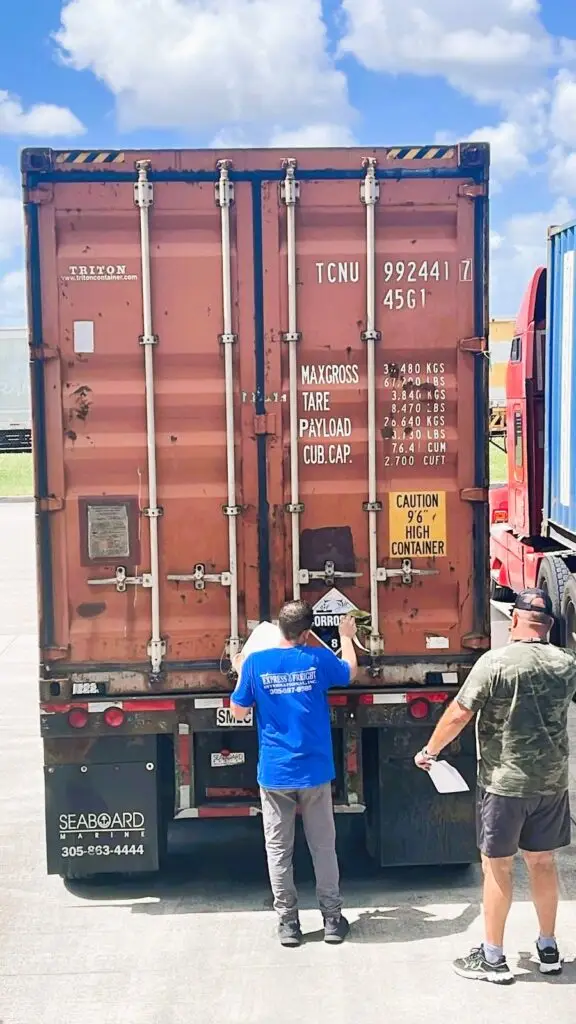
Is it hazmat, and who does what?
How do I know if what I am shipping is dangerous goods?
Start with section 14 of the safety data sheet. If there is a UN number and a proper shipping name in there, it is regulated. If section 14 says “not regulated for transport,” that is usually the end of it, but check which mode it is answering for, because the same product can be exempt by road and regulated by air. Send us the SDS and we will tell you where it lands, per mode, before you commit to a routing.
Can you just handle all of it for me?
We can do the classification work, build the declaration, sort the marks, labels, placarding and packaging advice, and sign the certification as your agent under 49 CFR 172.204. What we cannot do is remove your legal responsibility as the person offering the material. 49 CFR 173.22 puts that on you and it does not transfer. That is not us hedging. It is the reason to be careful about who prepares your paperwork.
Do you supply UN packaging?
We advise on the packing instruction, the packaging specification and the closure instructions, and we repack where that is the right answer. Packaging itself comes from a certified supplier, because the certification belongs to the manufacturer and the closure instructions have to come with it. If you are buying your own, buy the closure instructions with it and keep them. You are required to hold them, and a lot of shippers throw them away with the box.
What is the cutoff for a hazmat booking?
24 hours before the general cargo cutoff on that lane. The general cutoffs are published on the schedules page; take a day off whichever one applies to you. On a lane that closes Wednesday at 12:00 PM, hazmat closes Tuesday at 12:00 PM. And the cutoff is only the deadline. The classification, the packaging check, the segregation review and the declaration all have to be done before it. Send the safety data sheet as early as you can, especially if the classification is not settled. That is the part that takes time, not the freight.
Which edition of the rules applies to my shipment?
The one in force when the shipment is offered, for the mode it travels by. As of today that is IMDG Amendment 42-24 for ocean, mandatory since January 1, 2026, and the IATA Dangerous Goods Regulations 67th edition for air, valid through December 31, 2026. US domestic transport runs on 49 CFR, which is currently harmonized to the previous international cycle. The next harmonization rulemaking, HM-215R, was published as a proposed rule in February 2026 and is not final. A multimodal shipment can touch all of them, which is why the same box can be legal on the truck and refused at the airline.
Do you train my staff?
We are a freight forwarder, not a training provider, and we will not sell you a certificate. What we do is tell you plainly what your obligation is: hazmat employees need training at least every three years under 49 CFR 172.704, and anyone involved in offering dangerous goods by air is on a 24-month cycle. If you need a course, we will point you at a real provider rather than improvise one.
Can dangerous goods go into an LCL consolidation?
Sometimes, and the answer comes from the segregation tables rather than from us. Two materials that require any segregation at all cannot be stowed in the same cargo transport unit, which rules out a great many combinations in a shared box. Run your classes through the compatibility checker for the quick answer, then send us the UN numbers, because the entry for the specific material can be stricter than the class.
What happens if the classification turns out to be wrong?
Best case, a carrier catches it and your shipment is rolled. Worst case, nobody catches it and something happens in a hold or on a deck. In between sits an inspection, a fine measured against the penalty figures above, and a consignee waiting. We would rather have the awkward conversation with you at booking than write the incident report afterwards.
Adjacent, and free where we could make it free.
Start with the safety data sheet.
Section 14 tells us most of what we need. We classify it, build the declaration, sort the packing, marking and labeling, and book it by air, ocean or road with paperwork that survives an inspection.
Miami, FL 33166
(Medley)
8:30 AM – 5:00 PM ET
Read this before you rely on it
This page is general information about how dangerous goods transport is regulated and how we work within it. It is not a classification, not a compliance determination and not legal advice. The person offering a hazardous material for transport remains responsible for its classification, packaging and description under 49 CFR 173.22, whoever prepares the paperwork. Editions, variations and penalty amounts change. The positions stated here were checked on September 18, 2026, against the eCFR, the Federal Register, IATA and IMO sources listed below. Work from the edition in force for your mode at the time of shipment, and check carrier, state and operator variations for your actual routing before you book.
Sources
- 49 CFR 173.22: shipper’s responsibility for classification, authorized packaging, closure per the manufacturer’s instructions.
- 49 CFR 172.204: the shipper’s certification, and signature by an authorized agent.
- 49 CFR 172.704: hazmat employee training, recurrent at least once every three years.
- 49 CFR 107.329: civil penalties of $102,348 maximum per violation, $238,809 where death, serious illness or severe injury or substantial property destruction results, $617 minimum for training violations.
- 49 CFR 176.27(c): container packing certificate for a unit offered to a manned vessel.
- 49 CFR 176.83 and 177.848: segregation for vessel and for highway.
- IMDG Code, Amendment 42-24, mandatory from January 1, 2026.
- IATA Dangerous Goods Regulations, 67th edition, effective January 1, 2026, and the current IATA lithium battery guidance.
- UN Model Regulations, 24th revised edition (2025).
- PHMSA HM-215R, Hazardous Materials: Harmonization With International Standards: notice of proposed rulemaking published February 10, 2026, comments closed April 13, 2026, not final as of this date.
- IATA state variation BRG-05 (Brazil), as published in carrier regulatory notices. Confirm against the current DGR edition before booking.